

Stories
The best stories come from real life, so if you want something to say, go out and do something worth talking about.

I was talking with a friend the other day — a successful journalist — and he admitted he was going stale, that the passion behind his writing just wasn’t there.
The problem, he realized, was that he was spending too much time behind a desk. He hadn’t done anything lately that challenged him or scared him or filled him with a sense of possibility.
I thought about our conversation later that night and realized I was in the same uninspired boat. Too many of my story-worthy adventures have receded in the rearview mirror and I don’t have any new ones on the horizon.
That’s the essential and ongoing challenge for storytellers: To tell a story worth reading, you have to live a story worth telling.
And stories don’t come from scrolling or refreshing tabs. They don’t come from business meetings or socializing. They come from chasing adventure, going places, saying yes to challenges that might go sideways. They come from going out into the world in search of experiences.
A sign that I haven’t been out in the world enough is when I find myself repeating the same old stories at dinners or catch-ups.
Interesting conversations with friends and neighbors that once crackled with interest become predictable: what we’re watching on Netflix, a quick rant about the news cycle, and “character analysis” (aka gossip). Fine, but forgettable.
Then, yesterday morning, my brother, Chris, sent me a photo from his archives. Chris is a photographer, and two decades ago I pulled him into an assignment with me in the Pacific Northwest.
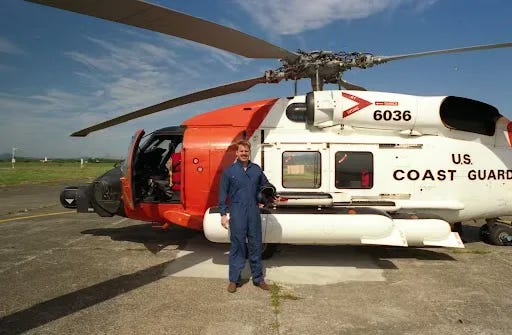
The photo at the top of this post is one he took of me before I hopped on the HH-60 Jayhawk helicopter behind me to report for a series of articles.
The photo created a flood of memories and pulled me back to one of the most interesting and adventurous jobs I’ve ever had.
Just a couple years out of college, I landed a gig at Navy Times covering the Coast Guard. I was the only journalist in America on that beat, and armed with a blank notebook and a press credential, I was able to experience Coast Guard air and sea operations up close.
Looking back, I’m still amazed at what I got to see and do.
At Coast Guard Station Cape Disappointment — where the Columbia River meets the Pacific in what’s known as the “Graveyard of the Pacific” — I watched crews train in 47-foot motor lifeboats designed to self-right after being flipped by monstrous waves.
At Air Station Astoria, I spent a day with an HH-60 Jayhawk crew and learned about “situational awareness.” Earlier that year, another crew flew into a mountain during a rescue attempt in heavy fog. The only trace left was an orange smudge on the hillside — and a photo of the wreckage that now hangs in the hangar as a quiet warning.
In Miami, a bold (or possibly insane) pilot let me take the controls of an HH-65 Dolphin helicopter as it tore across the Atlantic. I white-knuckled the stick, eyes locked on the gyro while trying to keep us level. I broke into a full body sweat.
Not long after, I flew on a C-130 to Guantanamo Bay, Cuba, then boarded a 110-foot cutter patrolling the Windward Passage. That night, standing midnight watch, I looked up and saw the Southern Cross shining brilliantly in the dark and felt an overwhelming sense of peace. Every time I hear the Crosby, Stills & Nash song, “Southern Cross,” I think of that moment.
And once, I hitched a ride on a G-4 jet from D.C. to Key West with the Commandant. A young officer brought along a key lime pie for the flight home — an all-time great ending to a press trip.
I made about $26,000 that year, but I came away changed by the experiences and with interesting stories to tell.
But when I saw that old photo my brother sent, it wasn’t nostalgia that hit me. It was a jolting reminder that if you want to live a good story, you have to go looking for one.
Journalism has given me permission to do that time and time again. But the truth is, we don’t need a press pass to do interesting things. We just need to step outside the algorithm and explore life.
I’m now planning my next adventure. Not for the Instagram post, but for the stories we’ll tell when sitting around the fire pit.
Doing interesting things with real people in the real world, that’s where I draw inspiration.
The well of creativity doesn’t fill on its own, you have pour yourself into life and drink deeply from the experiences you create.
So here's to the next great stories, yours and mine, the ones we’ve told and the ones that haven’t happened yet.
The Best Thing Ever Said About: Adventure
"In order to write about life, first you must live it." — Ernest Hemingway
Worth Reading:
Why I Came West, by Rick Bass
This is Bass’ account of why he walked away from a conventional life and moved to a remote valley in Montana, and what he found when he got there.
It’s about nature and aging, writing and purpose, and choosing to live in a way that feels fully alive, even when it’s hard or doesn’t make sense to anyone else.
Bass writes beautifully about the wild places, but also about what it means to commit to something — really commit — to land, to people, to a life you believe in.
What I love is that this isn’t some romanticized call to go live off the grid. It’s a book about paying closer attention to what matters and being willing to shape your life around it. That’s something I’m trying to do more of myself.
One line that’s stayed with me: “It’s not that I’m trying to stop time. It’s that I want to be fully awake and present as it passes.”
Whew! You read the whole thing! Now, a quick favor: Don’t click away without giving this post a heart/like below. Also, please share with anyone you think would enjoy reading this newsletter. We live in an algorithmic world, and your engagement helps Well Made Weekly get more visibility on Substack. Thank you so much for reading. I appreciate you!